
Our free-at-the-point of use healthcare system has always had a front door. A primary care clinic, the pharmacy counter and NHS 111 are the standard entry points for minor illness or initial assessments and referral further into that system. But for a growing share of the public that front door is now a self-started chat window. Before someone books an appointment - in fact before someone decides whether to bother at all - they’re now increasingly likely to seek information from an AI agent, without pausing to consider that the agent does not have access to your medical history, cannot physically examine you (although, somewhat terrifyingly, attempts are being made to do so virtually) and certainly can’t run a lab assay on your blood.
Despite this, the increasingly common action of treating your AI like a medical professional significantly changes what frames an individual’s first understanding of their symptoms, their condition and their possible treatment options. There is no campaign which has the power to stop people doing this, so healthcare communications strategy now needs to factor use of AI to gather health information into planned campaigns.
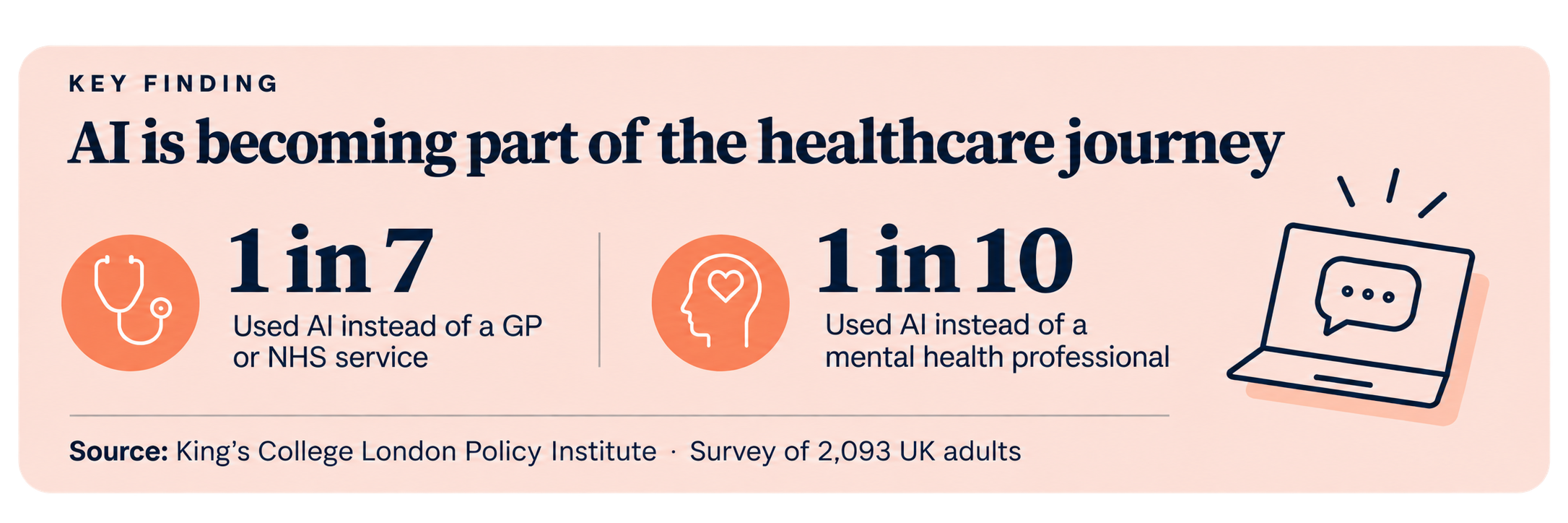
Recently, King's College London's Policy Institute surveyed 2,093 UK adults about AI in healthcare. One in seven said they had used a chat facility like ChatGPT, Claude or Copilot for health advice instead of contacting a GP or NHS service. One in ten said they had used AI instead of connecting with a mental health professional.
The reason isn't hard to find. A quarter of those who had swapped a GP for an AI conversation cited NHS wait lists. From this, we might conclude people aren't choosing AI because they trust it more than their doctor. They're choosing it because it answers instantly, with no 8am phone bunfight to get through.
The public is far from settled about it. Asked whether AI should play a part in clinical decisions, respondents split almost exactly down the middle: 37 per cent for, 38 per cent against. The MHRA has already warned that chatbots should not replace advice from healthcare professionals. But perhaps understandably, behaviour is running far ahead of the debate.
The Credibility Problem
Much of the industry conversation about this shift treats it as almost a technical fix under the banner of GEO optimisation - restructuring online copy into digestible Q&A chunks, adding some markup, tracking citation share, with the result that content is more likely to appear in an AI answer.
Some of that might be useful housekeeping, but to me misses what is really going on. When an AI answers a question about a new migraine treatment, or what an elevated PSA score means, it’s drawing on the sources it judges most credible and most consistently repeated.
Typically, those tend to be the sources healthcare PR has always worked to influence positively - NHS web pages, peer-reviewed journals, patient charities and support organisations, professional bodies, respected clinicians and mainstream health journalism.
In other words, the AI is trying to behave like a well-briefed health journalist and rewards the same things – a consistent message across trusted third parties.
What it means for comms pros is that the organisations which show up well in AI answers will mostly be the ones that already have a strong, coherent earned media presence. The ones that show up badly, wrongly or not at all will be those whose story lives only on their own corporate website.
Why This Matters For Pharma and Biotech
For pharma and biotech businesses in the UK there's an additional reason to treat this as a comms discipline rather than a marketing action. The ABPI Code of Practice prohibits the promotion of prescription-only medicines to the public. A content programme designed to get a branded medicine recommended to patients by an AI sits uncomfortably close to that line. “We were only optimising for AI” is not a defence anyone should try and test in front of the PMCPA.
The PMCPA's revised social media guidance, published in February 2026, shows the focus now placed on AI-generated patient information by the sector’s self-regulator. It is clear that companies are responsible for the acts and omissions of third parties acting on their behalf, including agencies, paid influencers and digital opinion leaders. It would be a brave reading of the ABPI Code to assume content engineered for AI engines sits outside this framework.
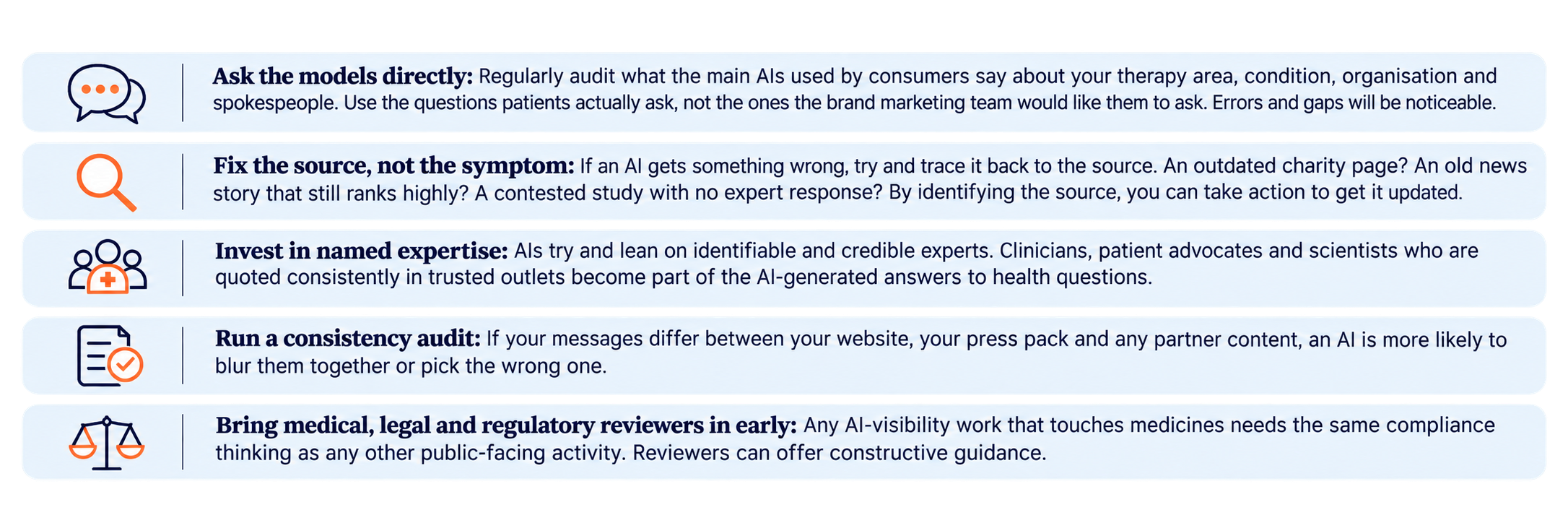
What the industry can do however is make sure accurate, balanced information about conditions and care pathways is present, well-sourced and carried by credible independent voices. That is work healthcare communicators already know how to do. It simply matters more now than it did a year ago.
What healthcare communicators should consider
Earned credibility has always been at the core of healthcare communications. The difference is that it is now being read, weighed and repeated at a scale no newsroom has ever reached. The organisations that come out ahead won't be the ones that found a trick to get into the answer. They'll be the ones that deserved to be there by taking a logical, balanced approach to updating and upgrading their own online content.